- Page d'accueil /
- Livres /
- Business & Money Books /
- Business Finance Books /
- Financial Engineering /
- Introduction To Machine Learning In Quantitat...
0 ratings

Numéro d'article:
39207490
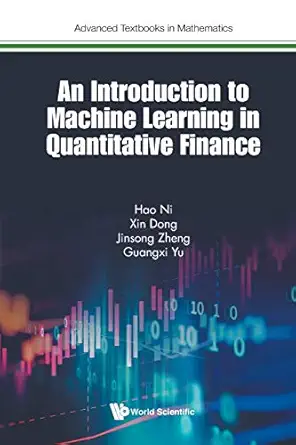
Introduction To Machine Learning In Quantitative Finance, An (Advanced Textbooks In Mathematics)
Numéro d'article:
39207490
CHF 62
Price Details
Excluding Shipping & Custom charges ( Shipping and custom charges will be calculated on checkout )
*All items will import from États-Unis
En stock
 Importé depuis la boutique USA
QTY:
Commandez maintenant et recevez votre commande aux alentours du Mercredi, Juin 24
Transaction sécurisée
Ubuy s'engage à protéger votre sécurité et votre confidentialité. Notre système avancé de sécurité des paiements garantit la confidentialité en chiffrant vos informations lors de la transmission grâce aux protocoles AES (Advanced Encryption Standards) et SSL (Secure Socket Layer). Vos coordonnées de paiement sont 100 % sécurisées car nous ne partageons pas vos informations de paiement avec des vendeurs tiers.
nos meilleurs partenaires logistiques


After reading An Introduction to Machine Learning in Quantitative Finance, ML tools will not be a black box to you anymore, and you will feel confident in successfully applying what you have learnt to empirical financial data!

Livraison
rapide

Retour
gratuit*

Emballage sécurisé

Produits 100 % originaux

Conformité PCI DSS

Certifié ISO 27001


Note: Step Down Voltage Transformer required for using electronics products of États-Unis store (110-120). Recommended power converters Acheter maintenant.


Ce qui se démarque
Advanced Mathematics
Offers a rigorous approach to machine learning concepts tailored for quantitative finance, enhancing analytical skills for professionals and researchers.
Real-World Applications
Focuses on practical implementations in finance, allowing readers to apply theoretical knowledge to solve industry-specific challenges effectively.
Comprehensive Coverage
Covers a broad spectrum of machine learning techniques and their integration into financial models, making it essential for deepening understanding and developing advanced strategies.
Détails du produit
- In today's world, we are increasingly exposed to the words machine learning (ML), a term which sounds like a panacea designed to cure all problems ranging from image recognition to machine language translation. Over the past few years, ML has gradually permeated the financial sector, reshaping the landscape of quantitative finance as we know it.An Introduction to Machine Learning in Quantitative Finance aims to demystify ML by uncovering its underlying mathematics and showing how to apply ML methods to real-world financial data. In this book the authorsProvide a systematic and rigorous introduction to supervised, unsupervised and reinforcement learning by establishing essential definitions and theorems.Dive into various types of neural networks, including artificial nets, convolutional nets, recurrent nets and recurrent reinforcement learning.Summarize key contents of each section in the tables as a cheat sheet. Include ample examples of financial applications.Showcase how to tackle an exemplar ML project on financial data end-to-end.Supplement Python codes of all the methods/examples in a GitHub repository. Featured with the balance of mathematical theorems and practical code examples of ML, this book will help you acquire an in-depth understanding of ML algorithms as well as hands-on experience. After reading An Introduction to Machine Learning in Quantitative Finance, ML tools will not be a black box to you anymore, and you will feel confident in successfully applying what you have learnt to empirical financial data!The Python codes contained within An Introduction to Machine Learning in Quantitative Finance have been made publicly available on the author's GitHub: https://github.com/deepintomlf/mlfbook.git Readership: This textbook is suitable for MSc students or final year undergraduate students in financial mathematics, machine learning or computational finance. It would serve as a graduate textbook in introducing machine learning and its applications in quantitative finance. It may also be appropriate for those interested in pursuing a career in quantitative finance or for practitioners in the financial sector who wish to develop an in-depth understanding of machine learning and its applications to finance.
| Publisher | WSPC (EUROPE) |
| Publication date | April 9, 2021 |
| Language | English |
| Print length | 262 pages |
| ISBN-10 | 1786349647 |
| ISBN-13 | 978-1786349644 |
| Item Weight | 15.5 ounces (439.43 grams) |
| Dimensions | 6 x 0.62 x 9 inches (15.2 x 1.6 x 22.9 cm) |
À qui est-ce destiné ?

-
Finance Professionals
Ideal for finance professionals looking to enhance their quantitative skills and apply machine learning in finance.
-
Graduate Students
Perfect for graduate students studying quantitative finance or related fields needing a deep understanding of machine learning.
-
Data Scientists
Useful for data scientists working in finance, helping bridge the gap between machine learning theory and financial applications.

-
Beginners
Not suitable for beginners without a foundational knowledge of machine learning and finance concepts.
-
Casual Readers
Not targeted at casual readers; demands a strong academic interest in machine learning and quantitative finance.
-
Practitioners Only
May not fulfill the needs of practitioners seeking practical, hands-on applications over theoretical learning.
DESCRIPTION DU PRODUIT
About This Item
Introducing "Introduction To Machine Learning In Quantitative Finance", an advanced textbook that bridges the gap between mathematics, finance, and machine learning. In today's rapidly evolving financial landscape, understanding the intersection of advanced mathematical techniques, quantitative finance, and machine learning is crucial. This compelling textbook provides a comprehensive introduction to these key areas, equipping you with the knowledge and skills to excel in the field. With a clear and concise writing style, this book covers a wide range of topics, including advanced mathematics, quantitative finance principles, and machine learning algorithms.
Whether you're a student or a professional looking to expand your expertise, this textbook offers a wealth of valuable information and practical examples to enhance your understanding. Designed as an essential resource for anyone interested in quantitative finance, "Introduction To Machine Learning In Quantitative Finance" delves deep into the various techniques and methodologies used in this complex field. From exploring the fundamentals of financial mathematics to applying machine learning algorithms in quantitative analysis, this textbook provides a solid foundation for mastering these specialized subjects. This book goes beyond the basics and delves into advanced concepts, allowing you to gain a deeper understanding of quantitative finance techniques. By incorporating machine learning, you'll learn how to utilize algorithms and statistical models to make data-driven decisions in the finance industry.
"Introduction To Machine Learning In Quantitative Finance" is not just a textbook; it's a comprehensive guide that covers a wide range of topics within the field. Whether you're interested in quantitative finance as a whole or want to gain deep insights into machine learning applications, this textbook will serve as an indispensable resource. Invest in your future by acquiring the knowledge and skills needed to thrive in the world of quantitative finance with "Introduction To Machine Learning In Quantitative Finance". Order your copy today and embark on a journey towards mastering the intersection of mathematics, finance, and machine learning.
Vous avez une question ? Chattez avec nous
Questions et réponses des clients
-
question:
What is 'Introduction to Machine Learning in Quantitative Finance' about?
répondre: This textbook provides a comprehensive overview of how machine learning techniques can be applied to quantitative finance. It covers fundamental concepts, algorithms, and real-world applications of machine learning in financial modeling, risk assessment, and trading strategies. By integrating theoretical foundations with practical examples, it helps readers understand how data-driven approaches can enhance financial decision-making. -
question:
Who would benefit from reading this book?
répondre: This book is ideal for graduate students, researchers, and professionals in finance and data science who want to deepen their understanding of machine learning in the context of quantitative finance. It also serves as a resource for educators looking to incorporate advanced machine learning concepts into their curriculum, providing a blend of academia and industry practices. -
question:
What are the key topics covered in this textbook?
répondre: The textbook delves into various key topics such as supervised and unsupervised learning, neural networks, and reinforcement learning, as they apply to financial scenarios. Additionally, it explores model evaluation, feature selection, and overfitting, offering insights into how to effectively implement these techniques within financial frameworks. -
question:
Is prior knowledge of machine learning required?
répondre: While prior knowledge of basic statistics and finance is beneficial, the book is structured to guide readers from fundamental concepts to advanced topics. It includes thorough explanations and examples, making it accessible for those who may not have an extensive background in machine learning but are eager to learn. -
question:
How does this book differ from other texts in quantitative finance?
répondre: This book distinguishes itself by focusing on the intersection of machine learning and quantitative finance, combining advanced mathematical techniques with practical financial applications. Unlike standard finance textbooks, this resource emphasizes computational techniques, providing readers with the tools to leverage machine learning in their analyses and strategies. -
question:
Are real-world examples included in the book?
répondre: Yes, the textbook includes multiple real-world case studies and examples that illustrate the application of machine learning methods in finance. This practical approach helps readers understand how theoretical concepts translate into actionable insights in the finance industry, enriching their learning experience with tangible outcomes. -
question:
Can this book help in algorithmic trading?
répondre: Definitely! The book provides insights into how machine learning techniques can be employed to develop trading algorithms. It discusses various strategies, model evaluations, and optimization methods that are crucial for constructing effective trading systems, making it a valuable resource for aspiring algorithmic traders. -
question:
What audience is this textbook intended for?
répondre: This textbook targets a diverse audience, including graduate students, quantitative analysts, statisticians, and finance professionals. It is particularly suited for those aiming to enhance their skill set with machine learning applications in financial modeling and analytics, allowing them to stay competitive in the rapidly evolving finance landscape. -
question:
Which mathematical prerequisites should I be aware of?
répondre: Readers should be familiar with linear algebra, calculus, and probability theory, as these subjects form the foundation of the machine learning techniques discussed. An understanding of basic financial concepts can also enhance comprehension. The text provides clarifications and references for any advanced topics, making it more approachable for various levels of expertise. -
question:
Where can I buy 'Introduction to Machine Learning in Quantitative Finance'?
répondre: In Switzerland, you can purchase 'Introduction to Machine Learning in Quantitative Finance' from Ubuy. Ubuy offers a streamlined online shopping experience, allowing you to conveniently access this advanced textbook along with other educational materials and resources.
Financial Engineering Editorial Review
Aucune critique éditoriale trouvée
Avis et évaluations clients
7 évaluations des clients
-
5 étoile
67%
-
4 étoile
14%
-
3 étoile
0%
-
2 étoile
0%
-
1 étoile
19%
Donnez votre avis sur ce produit
Partagez votre avis avec d'autres clients
Avantages
- Comprehensive coverage of topics
- Well-structured and organized
- Great for advanced learners
- Practical examples included
- Strong theoretical foundation
Les inconvénients
- Some sections may be too complex for beginners.
Historique des prix du produit
Informations importantes
- Limitations : Pour les produits expédiés à l'international, veuillez noter que toute garantie du fabricant peut ne pas être valide ; les options de service du fabricant peuvent ne pas être disponibles ; les manuels, instructions et avertissements de sécurité des produits peuvent ne pas être dans les langues du pays de destination ; les produits (et les matériaux qui les accompagnent) peuvent ne pas être conçus conformément aux normes, spécifications et exigences d'étiquetage du pays de destination ; et les produits peuvent ne pas être conformes à la tension et aux autres normes électriques du pays de destination (nécessitant l'utilisation d'un adaptateur ou d'un convertisseur le cas échéant). Il incombe au destinataire de s'assurer que le produit peut être importé légalement dans le pays de destination. En cas de commande auprès d'Ubuy ou de ses filiales, le destinataire est l'importateur officiel et doit se conformer à toutes les lois et réglementations du pays de destination.
- Tous les produits listés sur Ubuy ne sont pas à vendre, Ubuy étant un moteur de recherche mondial. Les produits sont soumis aux réglementations en matière d'exportation et de commerce.
CHF 62
Commandez maintenant et recevez votre commande aux alentours du Mercredi, Juin 24
This item is not restrict in my country.(Please click on above link if this item is not restrict in your country, So our team will review and allow.)
QTY:
Transaction sécurisée
Ubuy s'engage à protéger votre sécurité et votre confidentialité. Notre système avancé de sécurité des paiements garantit la confidentialité en chiffrant vos informations lors de la transmission grâce aux protocoles AES (Advanced Encryption Standards) et SSL (Secure Socket Layer). Vos coordonnées de paiement sont 100 % sécurisées car nous ne partageons pas vos informations de paiement avec des vendeurs tiers.
nos meilleurs partenaires logistiques
Livraison transfrontalière la plus rapide
Caractéristiques et avantages
- Demystify machine learning (ML) in quantitative finance
- Provide a systematic and rigorous introduction to supervised, unsupervised and reinforcement learning
- Dive into various types of neural networks
- Summarize key contents in cheat sheet tables
- Showcase an exemplar ML project on financial data
- Supplement Python codes of all methods/examples in a GitHub repository