- Page d'accueil /
- Électronique /
- Computer Accessories /
- Computer Components /
- Single Board Computers /
- for Arduino Nano V3.0 ATmega328P Module Ardui...
0 ratings

Numéro d'article:
148512483
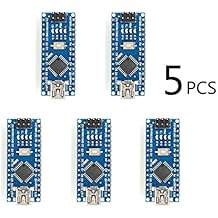
for Arduino Nano V3.0 ATmega328P Module Arduino Compatible Micro-Controller Board with Mini USB Interface
Numéro d'article:
148512483
CHF 39
Price Details
Excluding Shipping & Custom charges ( Shipping and custom charges will be calculated on checkout )
*All items will import from États-Unis
0 ratings
Écrire un commentaire
En stock
 Importé depuis la boutique USA
QTY:
Commandez maintenant et recevez votre commande aux alentours du Mercredi, Juillet 15
Transaction sécurisée
Ubuy s'engage à protéger votre sécurité et votre confidentialité. Notre système avancé de sécurité des paiements garantit la confidentialité en chiffrant vos informations lors de la transmission grâce aux protocoles AES (Advanced Encryption Standards) et SSL (Secure Socket Layer). Vos coordonnées de paiement sont 100 % sécurisées car nous ne partageons pas vos informations de paiement avec des vendeurs tiers.
nos meilleurs partenaires logistiques


Super small form factor, but full Arduino compatible!

Livraison
rapide

Retour
gratuit*

Emballage sécurisé

Produits 100 % originaux

Conformité PCI DSS

Certifié ISO 27001


Note: Step Down Voltage Transformer required for using electronics products of États-Unis store (110-120). Recommended power converters Acheter maintenant.


Ce qui se démarque
Compact Design
The Arduino Nano V3.0's miniature size makes it perfect for limited spaces, enabling easier integration into projects without compromising on functionality.
User-Friendly
With a mini USB interface, the Arduino Nano simplifies power and data connections, making it accessible for both beginners and experienced developers alike.
Versatile Compatibility
Designed to work seamlessly with various Arduino shields and modules, this micro-controller board allows users to easily expand their project capabilities and functionalities.
Détails du produit
| Item Weight | 0.1 lbs (50 grams) |
À qui est-ce destiné ?

-
Hobbyist Developers
Ideal for those experimenting with electronics and programming to create custom projects and prototypes.
-
Students Learning
Great for educational settings where students can learn about programming and electronics hands-on.
-
DIY Enthusiasts
Perfect for makers who want to build unique projects, such as robotics or home automation systems.

-
Advanced Engineers
May lack the capabilities and speed needed for high-level projects requiring more advanced microcontrollers.
-
Commercial Projects
Not ideal for scalable, professional-grade applications where reliability and support are critical.
-
Non-technical Users
Requires basic programming and electronics knowledge, making it unsuitable for those without any technical background.
DESCRIPTION DU PRODUIT
for Arduino Nano V3.0 ATmega328P Module Arduino Compatible Micro-Controller Board with Mini USB Interface
Vous avez une question ? Chattez avec nous
Questions et réponses des clients
-
question:
What is the Arduino Nano V3.0 ATmega328P module?
répondre: The Arduino Nano V3.0 ATmega328P is a compact micro-controller board that provides a versatile platform for building electronic projects. This module features the ATmega328P chip, which offers 32KB of flash memory for storing code and an array of digital and analog input/output pins. Its small size makes it ideal for projects with limited space, while the Mini USB interface allows for seamless programming and power supply. Users often utilize this board in projects such as robotics, home automation, and IoT applications. -
question:
How do I connect the Arduino Nano V3.0 to my computer?
répondre: To connect the Arduino Nano V3.0 to your computer, you need a Mini USB cable. Simply plug one end of the cable into the Nano's Mini USB port and the other end into a USB port on your computer. Once connected, install the Arduino IDE on your computer, which enables you to write and upload code to the Nano. This easy connection allows you to start programming your projects quickly, making it a favorite for both beginners and experienced developers. -
question:
What programming languages can I use with the Arduino Nano V3.0?
répondre: The primary programming language used for the Arduino Nano V3.0 is a simplified version of C/C++. With the Arduino IDE, you can write, compile, and upload your code. The syntax is beginner-friendly and provides various libraries to assist with tasks. Users can also use additional languages such as Python with specific libraries for Arduino. This versatility allows for a broad range of applications, from simple LED control to complex automation systems. -
question:
What projects can I create with the Arduino Nano V3.0?
répondre: The Arduino Nano V3.0 can be used for various projects, from simple to complex. Popular applications include building a temperature sensor, a digital clock, or a motor control system. Additionally, hobbyists use it for creating robots, home automation controls, and even wearable technology. Its compatibility with a variety of sensors and modules makes it a flexible choice for anyone looking to explore electronics and programming. -
question:
Is the Arduino Nano V3.0 suitable for beginners?
répondre: Yes, the Arduino Nano V3.0 is particularly suitable for beginners. Its compact size combined with an easy-to-use programming environment allows novices to get started with electronics and programming concepts without feeling overwhelmed. There is extensive community support, tutorials, and project ideas available, which can help beginners navigate their learning journey. This board is perfect for those starting in electronics and seeking a user-friendly introduction. -
question:
What are the differences between the Arduino Nano and Arduino Uno?
répondre: The Arduino Nano and Arduino Uno differ mainly in size, form factor, and the number of input/output pins. The Nano is smaller and designed for projects with limited space, while the Uno is slightly larger but offers more power. Both use the ATmega328P chip, but the Nano has a USB port for direct programming. Users may choose the Nano for breadboard projects or when a compact design is a priority, whereas the Uno suits larger projects with more connectivity. -
question:
Can I use the Arduino Nano V3.0 for IoT projects?
répondre: Yes, the Arduino Nano V3.0 is well-suited for Internet of Things (IoT) projects. While it doesn't have built-in Wi-Fi or Bluetooth capabilities, you can easily integrate additional modules to enable connectivity. For instance, using an ESP8266 Wi-Fi module or a Bluetooth module allows the Nano to communicate over the internet or with mobile devices. This adaptability opens the route to developing smart home systems, remote sensors, and IoT prototypes. -
question:
What types of sensors can I interface with the Arduino Nano V3.0?
répondre: The Arduino Nano V3.0 can interface with a wide variety of sensors including temperature sensors (like the DHT11), light sensors (such as LDR), motion sensors (like PIR), and more. Each sensor typically connects through the analog or digital pins. This flexibility allows users to create projects that measure environmental conditions, react to physical movements, or capture data, making the Nano a cornerstone of DIY electronics and automation. -
question:
What voltage does the Arduino Nano V3.0 operate on?
répondre: The Arduino Nano V3.0 typically operates on a voltage of 5V. It can be powered through the Mini USB interface or via an external source connected to the VIN pin, which can accept a range of voltages from 7V to 12V. This versatility makes it suitable for battery-powered projects or wall-adaptor setups. Understanding the power requirements is essential for optimizing your projects and ensuring reliable performance. -
question:
Where can I buy the Arduino Nano V3.0 ATmega328P Module in Switzerland?
répondre: You can purchase the Arduino Nano V3.0 ATmega328P Module at Ubuy. Ubuy provides a reliable platform for electronics and gadgets, offering various products to cater to your needs. With a selection of Arduino boards and accessories, Ubuy ensures that you can find everything required to kick-start your projects with the Arduino Nano. Be sure to check their website for availability and product details.
Ardest Single Board Computers Editorial Review
Aucune critique éditoriale trouvée
Avis et évaluations clients
1 évaluations des clients
-
5 étoile
100%
-
4 étoile
0%
-
3 étoile
0%
-
2 étoile
0%
-
1 étoile
0%
Donnez votre avis sur ce produit
Partagez votre avis avec d'autres clients
Avantages
- Compact and lightweight design
- Easy to install and use
- Wide community support
- Compatible with many shields
- Reliable performance
Les inconvénients
- Limited number of GPIO pins.
Historique des prix du produit
Informations importantes
- Limitations : Pour les produits expédiés à l'international, veuillez noter que toute garantie du fabricant peut ne pas être valide ; les options de service du fabricant peuvent ne pas être disponibles ; les manuels, instructions et avertissements de sécurité des produits peuvent ne pas être dans les langues du pays de destination ; les produits (et les matériaux qui les accompagnent) peuvent ne pas être conçus conformément aux normes, spécifications et exigences d'étiquetage du pays de destination ; et les produits peuvent ne pas être conformes à la tension et aux autres normes électriques du pays de destination (nécessitant l'utilisation d'un adaptateur ou d'un convertisseur le cas échéant). Il incombe au destinataire de s'assurer que le produit peut être importé légalement dans le pays de destination. En cas de commande auprès d'Ubuy ou de ses filiales, le destinataire est l'importateur officiel et doit se conformer à toutes les lois et réglementations du pays de destination.
- Tous les produits listés sur Ubuy ne sont pas à vendre, Ubuy étant un moteur de recherche mondial. Les produits sont soumis aux réglementations en matière d'exportation et de commerce.
CHF 39
Commandez maintenant et recevez votre commande aux alentours du Mercredi, Juillet 15
This item is not restrict in my country.(Please click on above link if this item is not restrict in your country, So our team will review and allow.)
QTY:
Transaction sécurisée
Ubuy s'engage à protéger votre sécurité et votre confidentialité. Notre système avancé de sécurité des paiements garantit la confidentialité en chiffrant vos informations lors de la transmission grâce aux protocoles AES (Advanced Encryption Standards) et SSL (Secure Socket Layer). Vos coordonnées de paiement sont 100 % sécurisées car nous ne partageons pas vos informations de paiement avec des vendeurs tiers.
nos meilleurs partenaires logistiques
Livraison transfrontalière la plus rapide
Caractéristiques et avantages
- Arduino Nano V3.0 is compact yet fully compatible.
- Features Mini USB and CH340 for reliable serial connection.
- Comes with preinstalled bootloader for quick setup.
- Perfect for fast prototyping and various projects.
- Compatible with Arduino IDE for ease of use.
- Offers two extra analog inputs (A6, A7) compared to Uno.